Friday, February 19, 2010

An interview with The Knack's Doug Fieger (1952-2010)


If you were alive and cognizant of your surroundings in 1979, you couldn't escape the pounding bass of "My Sharona." Everyone on earth seemed to follow the album's advice, and got The Knack — you couldn't listen to a radio for an hour without hearing them.

The Knack's reign was short, but incredibly influential — not just for the New Wave acts that immediately followed them in the early 80s, but for power pop bands of another generation. The Knack's blend of the bombastic, feel-good pop of their youth (Dave Clark 5, Paul Revere & The Raiders) with the Mod, lyrical sensibilities of The Kinks, in turn has doubtlessly inspired the punchy, chord-driven alternative rock of today. Green Day comes to mind.

Sabotaged by the very label that once touted them as the next Beatles, The Knack disappeared, then reappeared with a lower radar visibility — but nonetheless kept making great music.

Tragically, The Knack's career has come to a close with the passing of frontman/songwriter/guitarist Doug Fieger on Valentine's Day 2010. Fieger had been battling cancer for several years, a cancer that finally interrupted a flurry of activity for the band — who had enjoyed a noticeable rise in popularity at mid-decade. (Incidentally, the loss of Fieger was preceded by the passing of original drummer Bruce Gary in 2006).

As I listened again to an interview I had conducted with Fieger a few days after his 53nd birthday in 2005, I was struck by how much the singer was in love with music, after all this time. Fieger was an extremely gracious and genuinely nice man, and we had a remarkable, long conversation — we talked about all sorts of things, from his love of gardening to his appreciation of the Raiders' Mark Lindsay as one of the greatest rock singers, ever. But mostly about his love for his beloved band.

I saw The Knack a week or so later, at the new Tulalip Ampitheatre north of Seattle. Woefully under-promoted and under an unusually chilly August night sky, Fieger and Co. played for a few hundred people as if they were performing an arena show. Impossibly tight and as dynamic as one could imagine, The Knack erased decades of time passed as if their guitars were magic wands. It remains one of my most memorable concert experiences, ever.

Doug Fieger, may there be Telecasters in heaven.


SS: I still can't get over how you lost on Hit Me Baby, One More Time.

Fieger: Oh, it was much better that we lost. I'm serious... it generated controversy, and it kept the whole thing alive a lot longer. It was great.

SS: But you blew everybody away, and lost to Vanilla Ice!

Fieger: It's not about how good you are on television, with a "TV audience." Vanilla Ice had been on “The Surreal Life,” and his popularity was up.

SS: Did you have fun doing the show?

Fieger: Oh, absolutely. I have fun doing everything. I'm happy to be still doing the same thing that I've loved doing all my life... and I get to make a living doing it. It's great.

SS: Heck, I'd do it for free...

Fieger: Well, that's the thing... I joke that I get paid to leave home and stay in hotels and fly in airplanes; that's what I get paid for. (Otherwise) I'd do it for free.

SS: Did appearing on the show garner the band some attention?

Fieger: Oh, yeah, serious attention. Audiences have been exponentially bigger not just twice, but four times the size. It's been great.

SS: How did your gig at the Fuji Rock Festival go?

Fieger: It was amazing. 100,000 people. Amazing. There was eight stages; we played the main stage with Foo Fighters, Coldplay, Beck, New Order... we were on the stage with the big boys, and it was nice to be recognized.

Back in the day, we were gigantic in Japan. We were on the Japanese domestic charts, which was a big deal for overseas artists. It was nice that we were welcomed back to Japan with such a great response.

SS: From a fan's standpoint, the story of The Knack has been an infuriating one the breakup, no big comeback...

Fieger: That's not really true. We were really only apart for four years. And then we couldn't get a record deal that wasn't our fault; it was ridiculous, I mean, we had sold eight and a half million albums at the time. Capitol cut out our entire catalog for eight years, and wouldn't allow us to earn money for an eight-year period.

If anything that should infuriate the fans, it should be the music business, and not the band.

SS: Oh, I don't think the fans hold it against the band. What I was trying to say is that you should have been on top all along.

Fieger: Thank you, that's very nice for you to say that. We've always tried to do quality work. Every time we've gone into the studio, every time we've written a song, every time we get up on stage, we try to give 110 percent. I'm proud of every song on every record we've made. We've done exactly what we wanted to do... the difference has been the music business.

For example, Get The Knack was meant to be a double album — the first two albums were actually the "first album." Capitol wouldn't release a double album. Again, the record company created a problem. If we had released a double album, we wouldn't have been slagged by people as if ...But The Little Girls Understand was an inferior product — when it was really just, as Guns 'n' Roses did many years later, a record of stuff that just had to be left off the first album. No space for it.

We did a show with Journey a couple of years ago. Neal Schon came up to us backstage and said, "Man, your second album was one of the greatest albums ever recorded."  I said that he must be mistaken — he was probably talking about our third album, Round Trip. He said, "No, no, Let The Little Girls Understand."

So, there were fans who really loved that record, but it had the stigma of being this "less successful" follow-up to the first album. But it sold two-and-a-half million copies, which is not so bad.

SS: With the revival of power pop — Green Day, etc. — perhaps the time is ripe for another shot at mainstream success for The Knack.

Fieger: Well, we do what we do. I have no fantasies of becoming successful on the charts again. The fact that I'm making a good living doing what I'm doing... and 27 years after the band started, people are still calling me up to interview me, that's great.

We just played a show at a regular outdoor concert series here in Woodland Hills last night. It was huge; 5,000 people showed up to see us. I had no idea that many people would show up!

People continually come up to us and say, "You're better than you were 25 years ago." Hopefully we are. If you don't get better at something after years of doing it, you should give it up.

SS: Did you form The Knack as a power pop, Mod act?

Fieger: "Power pop" was a term invented by Pete Townshend to describe The Who back in the 60s, at least that's when I read about it.

We did have an idea of forming a band influenced by The Who and The Kinks — our two main influences. That was the idea, but nobody called it "power pop" in the beginning.

SS: Were you impressed by The Jam's power-pop, Mod splash overseas?

Fieger: I went to see them at the Whiskey-a-Go-Go when they were on their first tour here. I wasn't that impressed. I mean, I liked their energy, I appreciated the fact that they were doing the Mod thing, but...

SS: How about your cross-town rivals, The Beat?

Fieger: Well, I had known of Paul Collins when he was in a band called The Nerves, with Peter Case and Jack Lee. I went to see The Beat, he was a friend.

I never felt we had a rivalry with anybody. We had our own scene, our own group of fans, our own thing. We weren't part of the punk crowd, or anybody else's crowd. We were fortunate that (in LA) there was no specific "big thing" going on at the time, and we found our own way quickly. We were ready.

SS: Were you scared of the sudden rush of success?

Fieger: Oh, yeah. I don't know about scared, but it was... overwhelming. I thought I was ready for it, but there was no way to prepare yourself for something like that.

And it really was instant. We were playing a club like the Troubadour — 300 people — one night, and the next day we were the biggest group in the world. It was crazy, really crazy.

SS: With that beat, that bass line, didn't everyone think "My Sharona" was going to be a huge hit after first hearing it in the mixing room?

Fieger: Well, Mike Chapman did. Actually, Capitol didn't want to release it as a single. They thought "Oh Tara" should be the first single. That's why the album went to Number One before the single... "My Sharona" wasn't released until two weeks after the album.

SS: What happened to your Sharona?

Fieger: She's one of the most successful real estate agents in southern California. Sharona is the mother of two beautiful children. We've stayed friends, we talk a couple of times a year.

SS: I've rarely interviewed someone who has adjusted to the ups-and-downs of the business as well as you have seemed to. I detect very little, if any, resentment.

Fieger: Resenting what happens to you that's beyond your control — there's no purpose to it. Everything in life is designed to teach you something. I certainly wouldn't resent something that's brought me such wonderful opportunities as a song like "My Sharona" has.

Also, "My Sharona" is a fun song to play. Ask anybody who's played it.

(More photos of The Knack at the Tulalip Amphitheatre)

(NPR piece that included an interview with Sharona.)

Friday, February 5, 2010

Kid Creole & The Coconuts' Lifeboat Party


Embracing War-era music, August Darnall (aka Kid Creole) was a man ahead of his time. Commanding a stage filled with horns, rhythm and scantily dressed backup singers, the frontman's frenetic act pre-dated the swing-craze revival by almost 20 years.

And man, was it cool.  Cool – and unusual – enough to garner occasional airplay on Seattle's alternative music stations in the early 80s. An even more occasional appearances on MTV prompted more attention from American suburbia, though I have a hunch that Kid Creole's street popularity peaked on the East Coast and in Europe.

"Endicott," "Annie, I'm Not Your Daddy," "My Male Curiosity," "Caroline Was a Dropout," "Stool Pigeon"... the mix of funky R&B with Cab Calloway, 1940s jumpin' jive was irresistible, and reportedly was on Prince's turntable quite frequently. Though I had heard him on the radio, I first saw Kid Creole in action in the film Against All Odds, in a nightclub scene performing "Lifeboat Party." I was hooked, as the full Kid Creole experience combines the audio with the visual.

This live version of "Lifeboat Party" (seen above) is from 1985's Leisure Tour.

As we all know, sometimes an artist is too hip, too cool, too influential to reach the heights that their successors do, and such was the case with Kid Creole. Stuck somewhere on the dial alongside the Human League and Cyndi Lauper back in the day, the impresario was alone on a funky island of panama hats and wide silk ties. However, he never really left the room – Darnall and his Coconuts still perform occasionally, and an anthology was released in '09.

Thursday, January 21, 2010

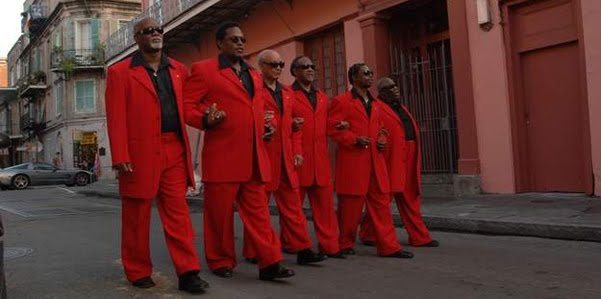
The Gospel Truth - Blind Boys of Alabama


I've interviewed a lot of musicians, but my recent chat with lead vocalist Jimmy Carter (!) of The Blind Boys of Alabama... well, this is one I'll never have trouble remembering.

We seemed to cover everything under the sun in about half an hour, but we could have easily talked all afternoon, as well.

I sat there in my chair and watched the rain come down past my window, in my hidey-hole north of Seattle, and listened to this weathered, yet vibrant voice coming through the wire from Montgomery, Alabama. We discussed the Blind Boys' latest CD — a collection of some of their guest appearances — and the pop artists who had asked the Blind Boys to record with them. We talked about what an unlikely pairing it was, the group meeting Lou Reed. Expectedly, faith frequently popped up.

The performer told me that that God denied him his sight because He wanted Carter to lead the life he had, as a gospel singer. Which led to a pause on my end of the phone. How do you respond to something like that?

We got along famously, and laughed a lot. Carter has a rich sense of humor; I suppose a man whose formative years were spent at the Alabama Institute For the Negro Blind, before touring and performing gospel music for decades — in good times and bad — would have to have a sense of humor. I even joked once about his being blind — it was that sort of conversation, and he is that sort of man. We were talking about the group's trademarked stage attire — tailored, colorful suits. I assumed that someone was around to make sure they all matched. We laughed again.

I bluntly broached the subject of touring churches with various gospel groups in the old Jim Crow South.

"Musicians like to complain about how tough it is on the road - counting pennies, sleeping in vans, etc.," I said, "I can't imagine dealing with those kinds of obstacles, plus being a black singer below the Mason-Dixon in the '50s and '60s."

And Carter told me exactly how it was — it was sometimes quite difficult. But he obviously got by — "With determination," he said. And, he added, with some help from the Lord. Carter explained that he and his bandmates were never hassled by the Klan or anyone — people looked out for them.

"But we knew our place — let's make that clear," he emphasized.

We knew our place. He uttered that words without a touch of sarcasm or bitterness in his voice, just matter-of-factly. I'd heard the phrase before, but never spoken to me. It stopped my brain in its tracks, though the conversation just rolled along.

It pains me to think of that phrase, to think of how such a wonderful man, such a great singer, once lived in an environment where the smart thing to do was to "know one's place." So long ago, but not long enough ago for a man who was there to forget. It makes me fightin' mad, just writing about it.

But Carter wasn't angry. He's a Grammy-winning gospel singer; a man dedicated to spreading Jesus' word through song. Anger is a bit out of place in his world.

We chatted on as if we were in my kitchen with a pot of coffee. Carter told me how he thanks God for his good life, and how he is surrounded by friends. He looked forward to the Blind Boys' appearance with Mr. Reed on the David Letterman show (which is tonight) and how much he was anticipating the group's upcoming performance for the President.

What a man. What a life of purpose, of conviction, of confidence in a higher power. What an interview.

View the full article here.

Wednesday, January 20, 2010

John Carter, Nick Cage and Benecio del Toro!


Though it's been planned, developed, discussed and brooded over for more than 70 years, Edgar Rice Burroughs' classic John Carter of Mars has never been brought to the big screen. However, someone's finally pulled the trigger, and principal photography has begun on a film adaption of the series.

The fact that Disney is the one with the trigger finger may or may not be cause for concern; apparently there is some backdoor Pixar involvement in this live-action flick, a potential big plus. On the minus side, the combination of Disney and its intended PG-13 rating means that Frank Frazetta's amazing, but highly erotic artwork won't be a stylistic template.

We'll have to wait and see if John Carter of Mars is a bold step for Disney, or something reminiscent of Island At The Top of the World...

In other flights of fantasy, I received the poster art for the upcoming Kick-Ass via email today. The comic book adaptation is supposed to be edgy as hell, but will Nick Cage be a contributor to the edginess, or serve as an unintended cheeseball counterpoint? Will we see the badass actor of the 80s, or the National Treasure, I-need-cash-to-buy-another-castle-for-the-IRS-to-take sellout? Again, time will tell... Kick-Ass is scheduled for an April 16 release.

Opening sooner is The Wolfman (Feb. 12), which I have high hopes for. Caught my first commercial/trailer recently, and I'm game. Hear that, studio? You've sold me. You don't need to air a half-dozen different commercials on various networks - a la Sherlock Holmes. You've got me hooked, don't lose me by airing every highlight of the film. Del Toro as the Wolfman... that's enough for me to part with 10 bucks. Of course, I'll probably be previewing this film for free, but you know what I mean. Just show a little leg, so to speak... don't give it all away.

Sunday, December 27, 2009

Remembering Vic Chesnutt - 1964-2009


As a fan or as a journalist, I have tried not to become too angry when an artist has taken his or her own life — "Oh, what a waste." Musicians and actors are, in the end, just like everyone else. For some, accomplishment, fame, and the admiration and love of friends and fans are just not enough when one is alone and weary and the demons — both of the mind and of the physical world — come calling. Try as you might, you can't put yourself in another's shoes, so exercises in speculation and judgment are as ignorant as they are pointless.

Having said this, the world lost an astonishingly gifted artist when singer-songwriter Vic Chesnutt passed away Dec. 25, after several days spent in a coma induced by an apparent overdose of muscle relaxants. He was 45. To many, including some of his musician peers, Chesnutt's death was not a complete surprise. The Georgia native spoke openly of his depression throughout his career; he had said that the condition pre-dated the 1983 car crash that left him confined — physically, at least — to a wheelchair.

I did not mention the wheelchair — either to him or to the readers — in an interview feature I wrote about Chesnutt's Silver Lake album in 2003.

Aside from being an overused topic, I didn't think it was relevant. Perhaps I was wrong. Obviously, Chesnutt's experiences and ongoing challenges heavily influenced his work. And what a body of work it was. Some 17 albums, with two in '09. Moreover, Chesnutt's quality surpassed, by leaps and bounds, the quantity of his output. A rare feat.

Vic Chesnutt was a unique songwriter with a unique voice. Like his friend Van Dyke Parks or Rufus Wainwright or even the esteemed Leonard Cohen, there was no one quite like him. He wrote and sang and spoke with an inimitable, Southern Gothic fashion that put the listener right in the middle of the story. With guitar perched on lap, Chesnutt examined humanity and his own human condition in the timeless style of an eccentric-genius writer of books, rather than a composer of lyrics. In that sense, he was frequently compared to his literary heroes, including Faulkner. Indeed, his songs were not cocktail-party accompaniment, trite Top-40 singles or catchy ringtones; by and large, Chesnutt songs were to be absorbed, considered, savored.

Most of all, Vic Chesnutt was bold; he had the sort of artistic strength that many of his more well-known admirers wish they possessed. Bold not just in choice of intimate or unusual topic (on Silver Lake, for example, he sang for 8:15 about a eunuch in a sultan's harem), but in style. As a singer and as a writer, he had the courage to develop an atypical approach all his own, and it worked. Chesnutt, who was no Orbison, had no qualms about shifting pitch or changing inflection to add flavor to his song-stories' characters; conventional tempos and structures were often fodder for tinkering. He was seemingly fearless.

After learning of Chesnutt's passing, one of first impulses was to dig out that interview tape to see if some insightful nugget had been edited out. I resisted the urge; maybe someday I'll re-write the whole thing, as my newspaper articles — with their prerequisite "Who Is He?" introductions to the artist — often make me wince when I re-read them. I don't think anything of importance was removed; while being gracious and thoughtful and extremely interesting, the songwriter replied to my queries pretty succinctly. I remember us talking at length about the eunuch and the harem ("Sultan, So Mighty"), and his fascination for observing people. It was a brief, somewhat enigmatic interview that I've thought about, now and then, ever since.

Finally, it would not be shameless, exploitive or insensitive to mention that plaguing Vic Chesnutt in recent years were his medical bills for surgeries and regular treatment. It would not be any of those things because he was a very vocal critic of America's health care system, and was reportedly in debt and in need of further operations at the time of his passing. If medical-related financial problems were a trigger for a working, touring, internationally acclaimed American musician's suicide... then the shame, exploitation and insensitivity are to be found elsewhere.

Mr. Chesnutt, may you find the peace elsewhere that so many wish you could have found in this world.

Monday, December 21, 2009

I've built my dreams around you


A tale of a stormy relationship between a woman and her eternally drunken louse of a lover, sung by a songbird princess and an infamously inebriated musical genius.

With such unusual subject matter, "Fairytale of New York" nonetheless became an instant Christmas staple 22 years ago. Captured on tape and film reel, this unlikely-yet-classic romance — with the Irish experience in America as a backdrop — has charmed millions on both sides of the Pond, including many who normally wouldn't include Pogues or Kirsty MacColl records in their cabinet.

And, as with the best Irish songs, one doesn't have to hail from the Emerald Isle to shed a tear over it.

One rare gem I've discovered this December is "The Story of... Fairytale of New York", a BBC documentary about both the song and equally epic video that helped catapult it up the charts at Christmas, 1987.

An all-encompassing study of the "Fairytale" phenomenon, the 2005 film is first-rate and faultless. It's centerpiece is bringing the Pogues together, for the first time, in the studio where their masterpiece album If I Should Fall With Grace From God was recorded. Around commentary from the band (if you wondered, in 1987, what Shane MacGowan would look like if he lived to the 21st century — here's your chance), the filmmakers weave the song's unusual origins, some interesting early footage of both the Pogues and MacColl, and inspired commentary by the likes of Nick Cave and Jools Holland. Famed producer Steve Lillywhite, MacColl's husband at the time, shows how the song was constructed while band members reminisce.

And, of course, there's the video. The documentary thoroughly examines the amazing clip, with recollections by actor Matt Dillon, set extras and members of the NYPD Pipe Band filling in for the fictitious "NYPD Choir."

Fittingly, this film honors the late, great Kirsty MacColl; in the wake of her untimely death in 2000, "Fairytale" has become her greatest musical legacy; "The Story of..." captures many sobering moments of remembrance from her family, friends and fans.

For Pogues/MacColl fans or for those who merely enjoy the song, "The Story of... Fairytale of New York" is a poignant must-see, particularly at this time of year. It's never been released on home video, but someone has painstakingly posted the hour-long documentary in six, high-quality segments on YouTube. So please steal ten minutes here and there and watch it, you'll thank me later.

Friday, December 4, 2009

Josie Cotton Meets The Ventures


A number of guest vocalists have dropped into the Ventures' world for a song or two over the years, but Josie "Johnny Are You Queer?" Cotton? Check this rare clip out, and you'll see it's not such a stretch.

After flourishing in the Japanese market in the 1970s, the Ventures enjoyed a lasting Stateside comeback that began in the early 80s, partly due to some inspired musicians paying tribute, either in the press or on record. Suddenly, surf music and twangy guitars were back. For example, the flip side of the Go-Go's "Our Lips Our Sealed" single, "Surfin' and Spyin'," was written as an homage to the band.

And then came Josie. After finding this 1985 performance of "Secret Agent Man" by accident on YouTube (looking for Cotton videos), I rang up Ventures co-founder/bandleader Don Wilson in hopes that he remembered some details about his encounter with the super-sexy New Wave icon.

"Of course I remember her," Wilson said, laughing. "It was love at first sight -- she was gorgeous, and that leather outfit..."

Wilson explained that the performance was part of a Japanese-produced special/documentary, filmed in NYC, that paired an eclectic array of Ventures admirers with the band onstage. Also featured were the Doors' Robby Krieger, Chris Spedding, Peter Frampton, David Johansen, the Doobie Brothers' Jeff Baxter, the Raybeats, Rick Derringer and Max Weinberg. According to Wilson, Cyndi Lauper was scheduled to appear, but when she couldn't make the gig, Cotton jumped in.

"And (Cotton) was great, she did a fabulous job, I think... great voice," Wilson added.

The special was never aired in the U.S., but is now available on DVD at The Ventures official website.

The Ventures -- who are about to celebrate an astounding 51st anniversary -- will perform at the Brian Setzer Orchestra's Christmas Rocks! Extravaganza, Dec. 17-18, at Universal City's Gibson Amphitheater.